Product · Knowledge layer
Fintology
The ontology your enterprise knowledge follows
In design
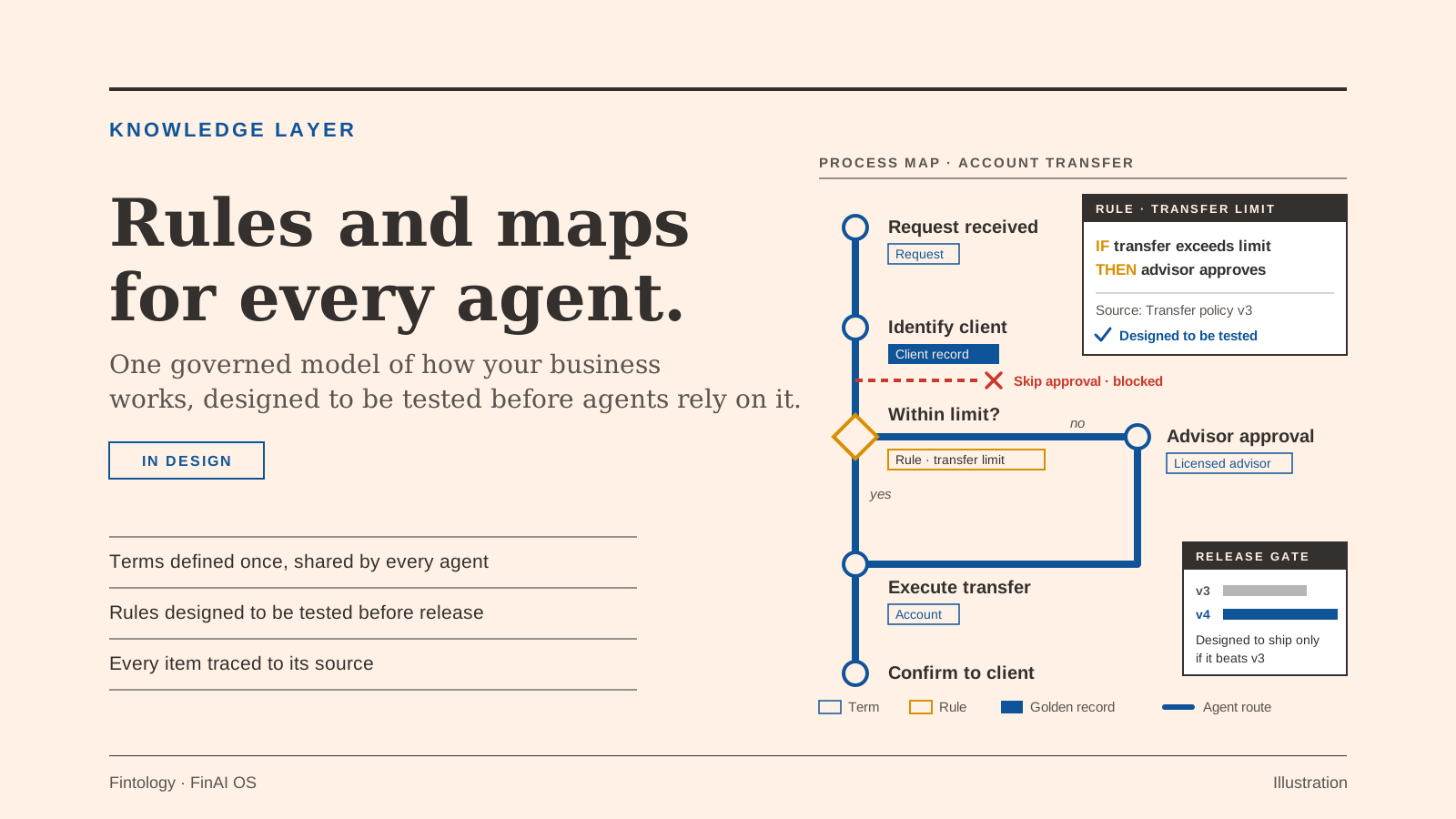
Agents fail quietly when "client", "account" and "household" mean different things in different systems, and when the way your best people actually work lives only in their heads. Fintology is designed to compile that knowledge into governed assets agents can rely on: a reviewed vocabulary, a model of your data, and tested process specs. Each piece traces back to its source. It is designed to be the rules, schema and ontology that FinLore's knowledge follows, so every agent works from one agreed model of your business.
Where it sits
The knowledge layer of FinAI OS
FinLore holds the knowledge agents read and cite; Fintology is designed to govern it. Fintology is designed to define what things mean in your institution and how they relate. Clients, accounts, products and obligations are designed to become one structured model. In the design, agents reach that model only through read-only tools for entity lookup, fragments of the ontology, and governed queries. They never touch raw client databases. The design keeps document Q&A separate from the compiler. The compiler is designed to own reviewed assets, and FinLore, the knowledge base, to hold read-only copies of what it publishes and answer questions from them.
In design. Designed to work on its own or with FinLore.
Capabilities
What Fintology is designed to do
Designed as three planes, each useful alone and stronger together. One is designed to define what things mean, one to make your data honour those meanings, and one to put both to work in agents.
- 1
Distil expert know-how
Designed to turn expert recordings, documents and interviews into versioned process specs (steps, decision rules, exceptions, terms), with every item linked to the source segment it came from. Experts are designed to review the specs before they become tested agent workflows.
- 2
Harvest an ontology from your systems
Designed to extract a versioned ontology from code, database schemas, API definitions and documents, using open standards and recording provenance for every term. In the design, bounded agents watch for drift and propose changes, and never edit the ontology directly.
- 3
Resolve records into golden records
Designed to match legacy records from different systems into one golden record per entity, in a governed graph with lineage, checked against shapes generated from the ontology.
- 4
Deterministic first, humans last
Designed so code and rules decide what they can, a model judges only the uncertain band, choosing from preset answers, and people make the remaining calls. Agents are designed to produce reviewable artifacts, never silent edits.
- 5
Released only when it improves
Designed so a new spec, ontology or mapping is published only if it beats its predecessor on a gold set, with autonomy granted in steps, from offline to shadow mode to assisted to limited autonomy: "No tests, no publish; no evidence, no autonomy."
Standalone · better with
Useful alone. Stronger in the stack.
Fintology is designed so each plane is useful on its own, starting with one narrow process or one entity type, and grows only when a real project needs the next plane.
Fintology alone
Fintology on its own: designed as a compiler for institutional knowledge
By design:
- Every term, spec item and golden record traceable to its source, version and run
- Append-only decision log: every alignment or match records its inputs, method and decider
- Source databases read through dedicated read-only roles; source code and documents parsed, never executed
- Client data, gold sets and client-specific rules stay inside the client's tenant
- Publishing in open standard formats, with every integration behind a replaceable interface
Better with
Fintology is designed to define the rules, schema and ontology FinLore's knowledge follows, and to publish reviewed content into FinLore, tagged by release, so answers come from it. FinLore's documents feed back in as evidence for review.
Fintology is designed to give the platform's agents read-only tools onto one agreed model of your business, instead of raw access to client databases.
Fintology is designed to expose read-only tools over a standard tool protocol, and FinClaw already calls remote tools that way.
In the wealth solution
Fintology in Personal Wealth Agents
Designed to hold clients, accounts, goals, products and duties as one structured model.
Client app and licensed advisor console shown on the solution page.
Deploy with FDE
Your institution's knowledge, compiled with the people who hold it
Our Forward Deployed Engineers already help customers build their ontology and knowledge graph: they connect your data sources, use agents to cleanse and resolve records, and work with your domain experts and data owners. Fintology is designed to carry that work, following a field-engineer workflow from scope and capture to reusable templates.
Talk to FDE- Step 1
Assess
Designed to start with one narrow process or entity type, a baseline, and captured sources and expert sessions, with consent recorded.
- Step 2
Ground
Designed to draft specs, ontology or mappings for experts to review in one workbench.
- Step 3
Hand over
Designed to score against a gold set, run in shadow mode, and raise autonomy only on evidence.
In design
Next step
Give your agents a model of your institution they can reason with
Talk with a Forward Deployed Engineer about building your ontology and knowledge graph, and the Fintology design behind it.